- Unwinding
- Myths and facts
- Evenings
Why simple puzzles help you unwind after work
Five common myths about winding down with a puzzle, what the research on recovering from work actually suggests, and a ten minute routine for the moment you get home.
 By JPott Studios
About a 7 minute read
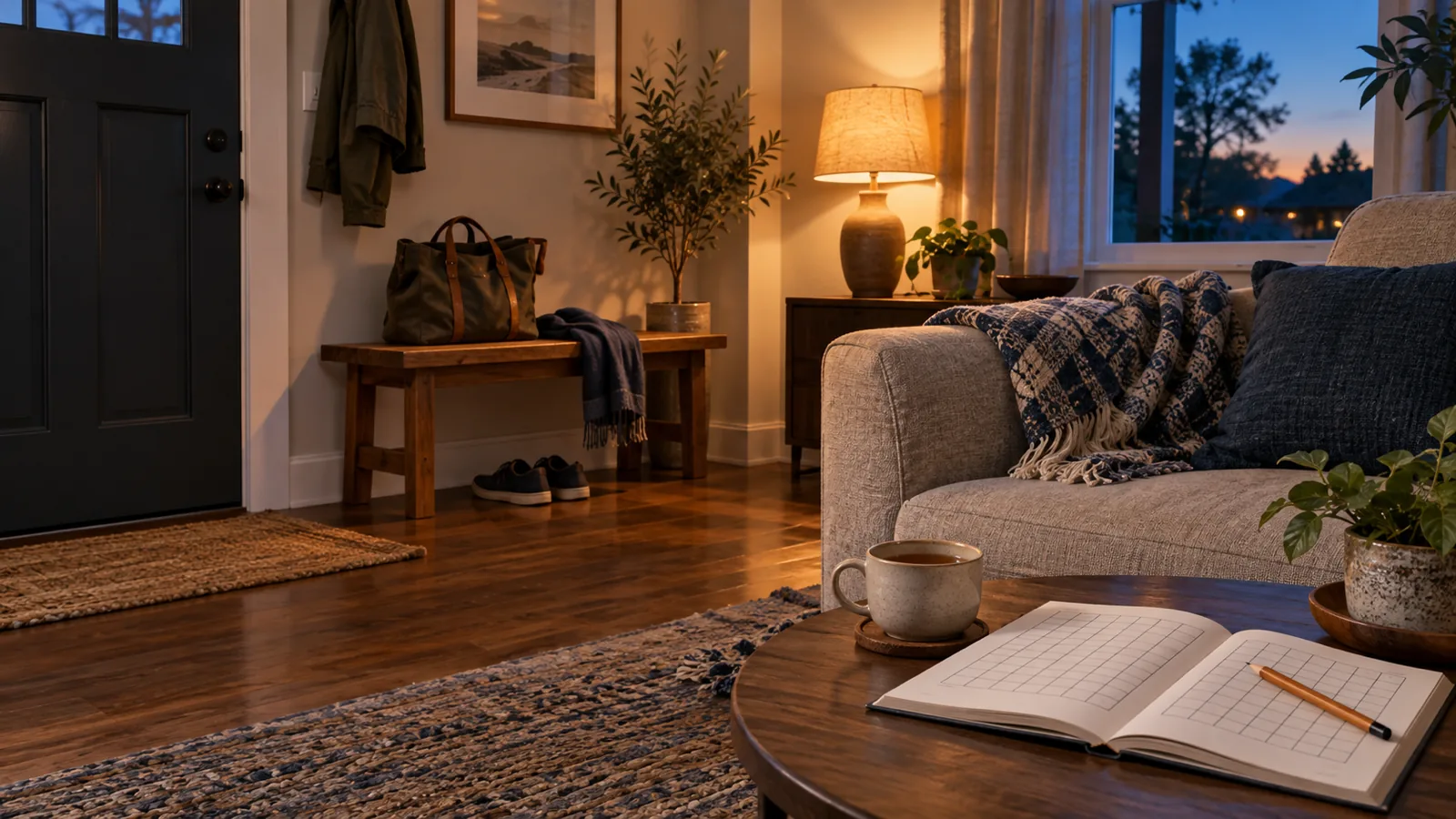
You get home, drop your bag by the door, and your thumb is already on your phone before your coat is off. Simple puzzles help you unwind after work because they swap the day's loose ends for one small, clear problem you can actually finish, and that shift of attention is exactly what a tired mind needs to let go of work.
Not every game does this, and there's a lot of odd advice about what relaxing "should" look like. So this guide tackles five common myths about unwinding with puzzles, one at a time, and ends with a ten minute wind-down you can try tonight.
Why do simple puzzles help you unwind after work?
Psychologists who study how people recover from work have a useful way to think about it. The researchers Sabine Sonnentag and Charlotte Fritz described four kinds of recovery experience in a 2007 paper, and a good evening usually includes at least one of them:
- Detachment: your thoughts are genuinely somewhere other than work.
- Relaxation: your body and mind slow down.
- Mastery: you take on a small challenge and get better at something.
- Control: you choose what you do, and when.
A simple puzzle ticks several boxes at once. It pulls your attention away from the inbox, it's a challenge you can win, and you decide when to start and stop. That's why ten minutes with a board can feel more restful than an hour of half watching something while your head replays a meeting.
Myth: to relax, you have to switch your brain off
The fact: doing absolutely nothing is harder than it sounds. When you sit down with nothing to hold your attention, the day tends to rush back in: the email you didn't send, the comment that stung, tomorrow's list.
A gentle task gives your mind somewhere else to go. It's the same reason people knit, do the washing up slowly or potter in the garden after a long day. The task is absorbing enough to crowd out work thoughts, but easy enough that it doesn't become work itself. A puzzle with one clear rule, like joining numbers with lines of the right length, is that kind of task.
Myth: any game on your phone will do
The fact: some games are built to calm you down, and plenty are built to keep you playing. The difference matters a lot at the end of a working day.
Lives that run out, adverts between levels, flashing offers when you fail and endless feeds all pull at your attention. They can leave you more wired than when you started. A calm puzzle is quieter: you can take your time, mistakes cost a tap on undo, and there's a clear moment when you're done. A time trial, if there is one, should be something you choose, not something that ends the round. We go into the details in why puzzle games with no lives or timers feel calmer.
It also helps when a puzzle has exactly one answer. You're not left wondering whether your solution counts, which is its own small kind of stress. Our guide on why one answer puzzles feel fair explains why that matters.
Myth: the harder the puzzle, the better it is for you
The fact: after work, the right puzzle is one that fits the energy you have left. The psychologist Mihaly Csikszentmihalyi, who wrote about flow, described that absorbed, time slipping feeling as happening when a challenge roughly matches your skill. Too hard and you get frustrated. Too easy and you get bored.
At the end of a long day, your skill feels a notch lower than usual, so drop the difficulty a notch too. Save the fiendish ones for a slow Sunday morning.
Which puzzle for which kind of tired?
Match the board to how the day left you.
Brain fried
- An easy board
- A jigsaw
- A word search
Restless and wired
- A medium logic puzzle
- A crossword
- A walled line puzzle
Flat and low
- A puzzle you know well
- Yesterday's board again
- One quick round, then out
If you'd like more ideas for the restless nights, our guide to logic puzzles for a calm break covers nine kinds, from easy to properly chewy.
Myth: it only counts if you play for an hour
The fact: a short puzzle with a clear ending often does more good than a long session. Five to fifteen minutes is enough to change gear from work to home.
The ending is the important part. A solved board gives you a small, satisfying full stop, a sign that one thing today is finished. Games without an end, where there's always one more level, never give you that moment, so it's easy to look up and find an hour has gone. Decide before you start: one board, maybe two, then something else.
From JPott Studios
One calm email a month
One useful tip, one free printable or tool, and a short note from our apps. Join and get the free welcome pack: printable trackers, a packing list maker and more.
Myth: a puzzle on a screen is just more scrolling
The fact: it's not the screen that makes scrolling draining, it's the endlessness and the noise. A feed never runs out and keeps throwing new things at you. A puzzle board sits still and waits for you to think.
That said, screens late at night can make it harder for some people to settle, so be honest about how they affect you. If they do, play your puzzle in the early evening and keep the last hour before bed for something on paper, a book or a bath. A pencil puzzle book works just as well as an app for unwinding.
A ten minute wind-down you can start tonight
Here's a simple routine that puts all of this together. It works with any calm puzzle, on paper or on a screen.
From work mode to home mode
About ten minutes, once you're through the door.
- Change somethingSwap your work clothes or shoes. A small physical signal that the day is over.
- Park tomorrowWrite tomorrow's first task on paper, so your mind can stop holding it.
- Solve one boardAn easy or medium puzzle, with a drink beside you and nowhere to be.
- Put it downClose it when it's solved and move on to dinner, a walk or a chat.
That second step has good research behind it. In a 2011 study, the psychologists E. J. Masicampo and Roy Baumeister found that making a specific plan for an unfinished task helped stop it from intruding on people's thoughts while they did something else. Writing it down tells your brain it's handled.
If you'd like a daily version of this habit, our guide to a calm daily puzzle routine shows how to keep it a pleasure rather than a chore. Linelet, the puzzle game we make, was built for moments like this: two new boards a day, each with one fair answer, and no ads or lives. You can also try today's free board in your browser.
Unwinding with puzzles: your questions
Are puzzles good for relaxing after work?
For a lot of people, yes. A simple puzzle gives your mind one small, clear problem to think about instead of the working day, and it ends with a solved board. Pick one that's easy to medium for you, with no ads or pressure, and stop after one or two.
What kind of puzzle is best for unwinding?
One with clear rules, a definite finish and no penalties for mistakes. Number line puzzles, sudoku, nonograms, crosswords and jigsaws all work well. If your head is foggy, go easier than usual. If you feel restless, something with a bit more to chew on can help.
How long should I play a puzzle to unwind?
Five to fifteen minutes is plenty for most people. The point is to change gear, not to fill the evening. Decide in advance that you'll play one board or one round, then put it down.
Is it okay to do puzzles on my phone before bed?
A short puzzle in the early evening is fine for most people. If you find screens keep you awake, finish it well before bed, turn the brightness down, or switch to a paper puzzle for the last hour of the night.
Why do some games make me feel more stressed, not less?
Many games are designed to keep you playing, with lives that run out, countdowns, adverts and offers when you fail. That pressure is the opposite of what you want after work. A calm puzzle lets you take your time and stop whenever you like.
From JPott Studios
One calm email a month
One useful tip, one free printable or tool, and a short note from our apps. Join and get the free welcome pack: printable trackers, a packing list maker and more.